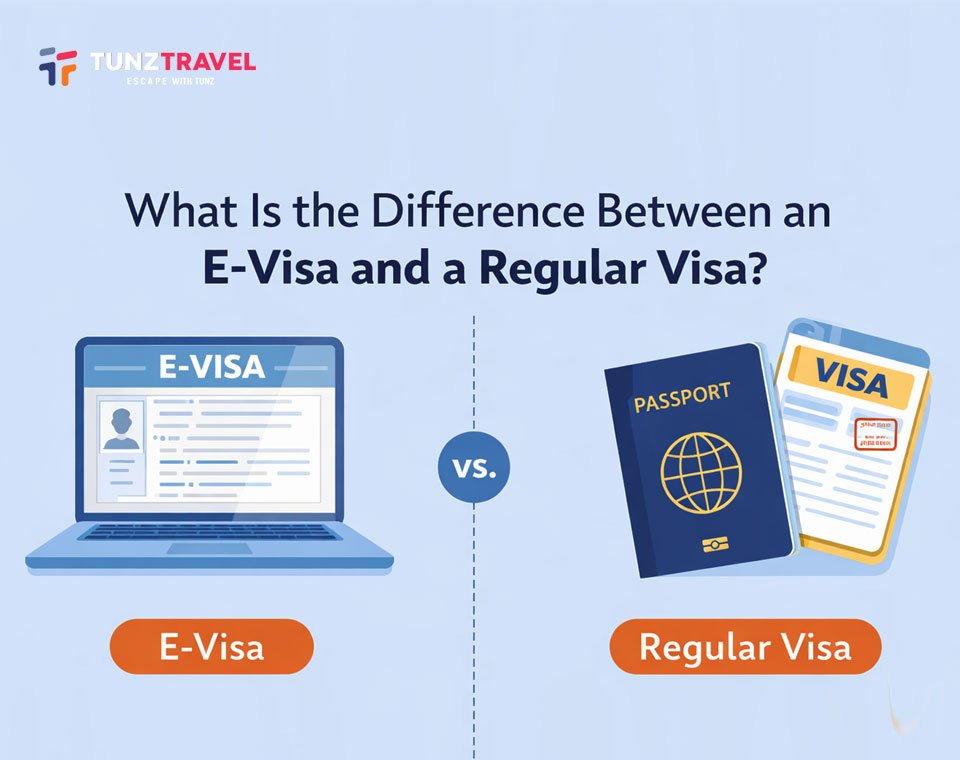
For planning an international trip, it is necessary to know about the different types of visas. The E- Visa and the Regular Visa are the two most frequent ones. Although both of them provide legal access to the country, they are considerably different in terms of application, processing, and usage. To make the correct choice, then let us discuss the major differences.
What Is an E-Visa?
E- Visa (Electronic Visa) is an online travel permission that you can request. It dispels the necessity to move physically to an embassy or a consulate.
- The application is filled via an official government portal.
- Digital uploading of required documents is made.
- Upon receiving approval, the visa is mailed through email.
- When entering the country travelers normally carry print copy or digital copy.
E-Visas are convenient and therefore best suited for short-term travel and this includes tourism, business visits or even transit.
What Is a Regular Visa?
A Regular Visa is the modern visa which is stamped or affixed to the bottom of your passport. It entails a formal and elaborate application process.
- Needs going to an embassy or a consulate.
- Includes biometric data submission and interviews often.
- Physical paperwork and documentation are involved.
- Upon approval, you have Visa stamped in your passport.
Long-term visits, which include education, work or immigration, are normally done with the help of regular visas.
Application Process Comparison
One of the largest differences is the process of application:
- E-Visa: all online – complete a form, attach documents, pay money and wait to be approved. No appointments required.
- Regular Visa: In this case, one has to make appointments, visit visa centers, file physical papers, and occasionally sit for an interview.
Simply put, with E-Visas, one has convenience and speed, whereas with Regular Visas, there is a more organized process and a formal approach.
Processing Time
- E- Visa: It is usually completed in a few days (even 24- 72 hours).
- Regular Visa: It may take few days to weeks depending on the country and the type of visa.
Depending on the demand, accuracy of the documents, and immigration policies the processing time might be shortened or extended. You can always contact to a best visa agency in Dubai like Tunz Travel to take care of the submission task.
Required Documents
E-Visa:
- Passport copy.
- Travel itinerary.
- Basic personal details.
Regular Visa:
- Passport and photos.
- Bank statements.
- Employment or income proof.
- Invitation letters (where necessary).
- Further attaching documentation.
The regular visas usually need more elaborate records to check the objective and period of accommodation.
Cost Difference
- E-Visa: It is generally cheaper or mid-price because of minimal processing.
- Normal Visa: It is more costly in most cases because of service fees, biometric expenses, and the cost of processing.
Fees however differ according to the country and type of visa.
Validity and Stay Duration
E-Visa:
- Short-term validity.
- Typically, single or restricted access.
- Perfect when traveling for a tour or making a business trip.
Regular Visa:
- Longer validity periods.
- Several options of entry.
- Appropriate to study, work or long stay.
Which One Should You Choose?
An E- Visa or a Regular Visa depends on your travelling needs:
- E-Visa is the easy way to go when dealing with short trips.
- Select a Regular Visa when you intend to spend a long time or to make several visits or even when you are working or studying.
In a Nutshell
Both E-Visas and Regular Visas provide a person with legal entry to a country, however, to satisfy different traveling purposes. E-Visas are quick, convenient, and ideal in case of a short visit, whereas Regular Visas are flexible and have higher validity in case of a serious commitment. Knowing these differences would make your journey easy and you would not have to waste a lot of time in needless delays. To ensure that you will have a hassle-free time when travelling, always ensure that you have checked the specific visa requirements of your destination country before applying.